
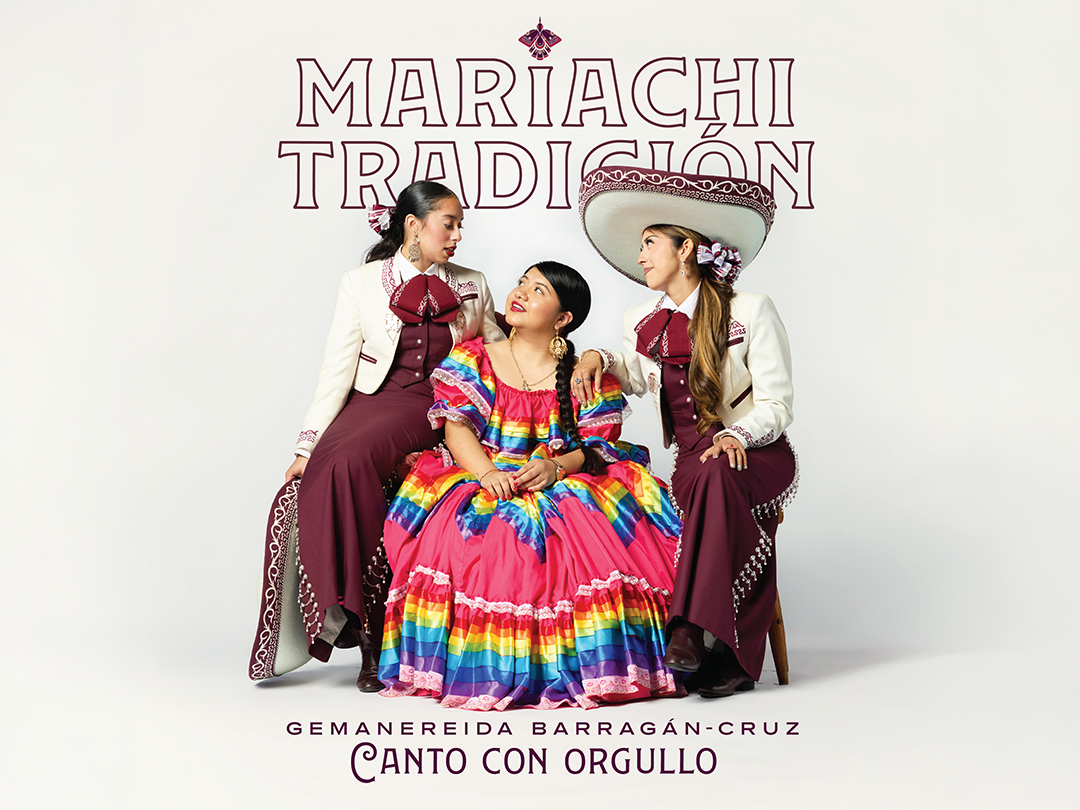
Mariachi is one of Mexico’s most treasured musical traditions—a living art form passed from one generation to the next through family, community, and celebration. Its songs tell stories of love and loss, joy and resilience, homeland and belonging. As people have crossed borders, they have carried this music with them, allowing it to flourish in new places while remaining deeply rooted in its cultural heritage.
This album celebrates that enduring tradition. For these young musicians, performing mariachi is more than learning a musical style; it is an act of preserving memory, identity, and culture. In moments of yearning, the music becomes a voice for those separated from home, carrying cherished memories while ensuring traditions are never forgotten.
Here, that tradition lives on through the voice of Gemanereida Barragán Cruz, a 20-year-old music student born and raised in Oregon, performing alongside her fellow Oregonians in Mariachi Tradición, the Forest Grove High School mariachi ensemble. Together, they honor the generations—their own and their parents’—who brought this music north while carrying it forward for new audiences and communities.
This recording celebrates cultural inheritance, reminding us that while people may journey far from their place of origin, music has the remarkable power to carry home across borders, generations, and time.
1. Al Mariachi de Mi Tierra
Composer: José “Pepe” Guizar Morfin
Arrangement: Jose Hernandez (for Mariachi Reyna de Los Angeles)
A joyful celebration of the spirit and enduring tradition of mariachi, this piece honors the generations of musicians who have kept this beloved art form alive, passing it from one community to the next. This song honors both the music and the homeland—mi tierra—while acknowledging the deep roots of mariachi in regions such as Jalisco. It stands as a homage to tradition, identity, and the enduring pride carried through this vibrant musical style.
The bright presence of trumpets, vihuela, and guitarrón immediately sets a celebratory tone, while the violins introduce a graceful melodic line. Together, these elements create the rich, dynamic sound that defines mariachi—uplifting, expressive, and full of life.
2. Los Mandados
Composer: Jorge Lerma
Arranger: Pedro Ramirez
Los Mandados is a spirited contemporary ranchera that tells a story of determination and the pursuit of a better life. Rooted in the traditions of rural Mexico, ranchera music gives voice to the human experience—expressing love, struggle, pride, and a deep connection to homeland.
While playful in tone, the piece speaks to a deeper truth shared across many communities, where hard work shapes the rhythm of daily life. Across fields, kitchens, homes, and long journeys of travel and labor, countless individuals move forward with resilience, responsibility, and hope. Beneath its humor lies a powerful reminder of the dignity of work and the strength found in everyday perseverance.
3. Canción Mixteca
Composer: José López Alavez
Arranger: Rubén Fuentes
At its heart, this is one of the most profound expressions of longing in the Mexican musical tradition, giving voice to the experience of being far from home. In this performance, Gema’s remarkable voice carries the depth of nostalgia with clarity and restraint, while Mariachi Tradición surrounds her with dignity and sensitivity, allowing each phrase to unfold with emotional honesty.
The performance honors the song’s expressive simplicity, allowing its timeless message to resonate naturally through sound. Canción Mixteca reminds us that home is never only a physical place; it is something carried within us—preserved through music, held in memory, and felt across any distance, even across borders both real and imagined.
4. Paloma negra
Composer: Tomás Méndez Sosa
Arranger: Rubén Fuentes
Paloma Negra is one of the most powerful expressions of emotional intensity in the Mexican ranchera tradition. Composed by Tomás Méndez, the song is often understood as a story of romantic heartbreak. In Gema’s interpretation, however, it expands into a broader reflection on longing, distance, and emotional displacement—feelings that resonate deeply with the experiences of migration and the search for belonging.
At its core, the song expresses the ache of holding on to something just beyond reach: a love that cannot be reclaimed, yet cannot be forgotten. This same emotion echoes the experience of being separated from home, where memory becomes both comfort and longing, and where absence remains a powerful presence.
5. Hermoso Cariño
Composer: Fernando Z. Maldonado
Arranger: Rafael Carrión
Hermoso Cariño is a celebration of love expressed with clarity, warmth, and sincerity. Within the ranchera tradition, often shaped by longing and heartbreak, this song offers a different perspective: one of gratitude, presence, and emotional steadiness. At its core, it speaks to the quiet strength of companionship and the enduring power of love.
In this performance, that sense of sincerity is carried through the voice and supported by the warmth of the mariachi ensemble. The rhythmic foundation provides gentle movement, while the violins and trumpets shape the melody with subtlety and grace. Together, they create a sound that feels both intimate and expansive.
6. Amor Eterno
Composer: Juan Gabriel
Arranger: Rigoberto Alfaro
“Amor Eterno” is a song of grief, remembrance, and love that endures beyond death. Rooted in a deeply personal story, it gives voice to the emptiness left when someone is gone—where memory becomes both comfort and a reminder of what cannot return. Rather than resolving this tension, it holds it, honoring how love persists even in separation.
In this performance, Gema dedicates the song to those we have lost—those who left too soon, those still missing, and those whose journeys were cut short by migration, hardship, or uncertainty. It invites us to pause, reflect, and remember the absences that continue to shape our lives.
7. La Gloria Eres Tú
Composer: José Antonio Méndez
Arranger: Ruben Fuentes
La Gloria Eres Tú is one of the most enduring expressions of love in the Latin American songbook. Born from Cuba’s intimate, jazz‑inflected filin movement, it has also become a cornerstone of the Mexican bolero tradition. The song unfolds as a quiet confession in which love rises beyond the earthly and approaches the divine, elevating the beloved to the embodiment of glory itself.
In this performance, the dialogue between Gema’s voice and Mariachi Tradición brings fresh clarity to its emotional arc. Her phrasing—supported by warm strings and subtle accompaniment—lets the text breathe while honoring the tradition that shaped it.
8. El Noa Noa
Composer: Juan Gabriel
Arranger: Carlos Antonio Uribe
Originally written and performed by Juan Gabriel, this song evokes a place where life feels lighter—a place where people gather to dance, let go, and be fully present with one another. It reminds us that even in difficult times, music creates spaces where joy, movement, and community can flourish.
The song also holds a special place in Gema’s heart as a cherished family favorite, making this performance both deeply personal and joyfully shared. It invites us to embrace openness and connection, offering a chance to find common ground and set aside what divides us, even if only for a moment.
9. Viva México
Composer: Pedro Galindo
Arranger: Silvestre Vargas and Gaspar Vargas
El Grito–Viva México brings this album to a close at a moment when Mexico is remembered, celebrated, and felt across generations. it reflects everything that has come before it: the longing of Canción Mixteca, the intensity of Paloma Negra, the storytelling of Los Mandados, and the joy of El Noa Noa. All of these threads converge here into a single expression of belonging.
Viva México stands as both conclusion and celebration. It invites us to leave as participants in a shared tradition that continues to live, breathe, and resonate far beyond its borders.
Gemanereida Barragán Cruz & Mariachi Tradición
Directed by Lesslie Núñez
Musicians
Gemanereida Barragán Cruz — Vocals
Violins
Dulceluna Cabrera Gómez — Violín I
Kayden Samuel — Violin II
Audrey Phuong — Violin III
Emilia Aguirre — Violin IV
Theresa Echeverría Garfias — Violin V
Guest Appearance
Gladimir B. Cruz — Accordion
Trumpets
William Parra — Trumpet I
Emilio Girón — Trumpet II
Rhythm Section
Xóchitl González-Viveros — Harp
Marc Fernández-Reyes — Guitarrón
Brandy Beltrán-Vega — Vihuela
Armando Vega González — Guitar I
Theresa Echeverría Garfias — Guitar II
Production Credits
Produced by The Immigrant Story
Executive Producer: Sankar Raman
Recorded by Justin Phelps
Recorded at Hallowed Halls, Portland, Oregon
Mixed and Mastered by Justin Phelps at Hallowed Halls, Portland, Oregon
Cover Photography: Ben Mund
Graphic Design: Meagan Ghorashian, Brolly Design Co., Portland, Oregon
Canto Con Orgullo is a production of The Immigrant Story. This album was made possible through the generous support of The Collins Foundation.
℗ & © 2026 The Immigrant Story. All rights reserved.
This post was originally published on this site